

Understanding what environmental impact is has never been more important. In a world increasingly affected by climate change, pollution, and biodiversity loss, knowing the causes, effects, and possible solutions becomes a shared responsibility.
In this guide, we explore the key concepts, measurement tools, and strategies to reduce our ecological footprint, with a focus also on the role of companies and how WildSteps supports them in the sustainable transition.

Table of contents
What is environmental impact?
Understanding what environmental impact means is the first step toward acting consciously. This concept includes the transformations, often negative, that human activities cause in the environment.
Definition and meaning
Environmental impact is the set of consequences that human activities generate on the natural environment. It includes greenhouse gas emissions, the consumption of non-renewable resources, ecosystem degradation, and biodiversity loss.
When we talk about “environmental impact,” we refer to the direct and indirect effects that affect air, water, soil, flora, and fauna. Every choice we make, whether personal or collective, influences the balance of the Earth.
Difference between environmental impact and pollution
The two concepts are often confused, but they are not synonyms.
Pollution is a form of environmental impact linked to the spread of harmful substances in the environment.
However, environmental impact is a broader concept. For example, land sealing, habitat loss, or the overexploitation of natural resources also represent environmental impacts, even though they are not “pollution” in the strict sense.
A useful indicator for better understanding this phenomenon is the ecological footprint, which measures how much human activity exceeds the planet’s regenerative capacity.
The main causes of environmental impact
Environmental impact comes from multiple sources, linked both to production systems and to individual behaviors.
Industry, agriculture, and transport
The sectors with the greatest impact in terms of global greenhouse gas emissions are:
- Energy use in industry: 24.2%
- Agriculture, forestry, and land use: 18.4%
- Transport: 16.2%
- Energy use in buildings: 17.5%
- Industry, processes, and production: 5.2%
These sectors represent the main areas where urgent action is needed.
Lifestyles and consumption patterns
Citizens’ everyday choices also have an impact on the environment. Overconsumption, food waste, excessive energy use, and frequent travel increase pressure on ecosystems.
Although part of the population is aware of the risks and environmental impact, often experiencing states of eco-anxiety, the majority continues to exploit the Earth’s resources disproportionately.
A key concept for understanding this imbalance is Overshoot Day, the day of the year when humanity consumes all the resources the Earth can regenerate in one year.
To understand your own impact, you can calculate what your personal Overshoot Day would be.

Assessing and measuring environmental impact
You cannot improve what you do not measure. That is why specific tools and processes exist to assess environmental impact objectively.
Environmental Impact Assessment (EIA)
Environmental Impact Assessment (EIA) is mandatory for certain public and private projects that may have significant effects on the environment.
These include road, railway, and airport infrastructure, large-scale energy and industrial plants, and building works in sensitive or protected areas.
EIA is used to predict and analyze environmental effects before a project is carried out, proposing measures to mitigate damage and involving institutions and communities to ensure transparency and participation.
This tool, required by European and Italian legislation, helps combine development and environmental protection, promoting more sustainable and responsible decisions.
Indicators and metrics: ecological footprint and CO₂
Two of the most widely used tools for measuring environmental impact are:
- Ecological footprint: it quantifies the biologically productive area needed to produce the resources consumed by a population and absorb the waste generated.
- CO₂ emissions: they measure the impact on climate change and represent one of the main metrics used by governments, companies, and researchers.
Strategies to reduce environmental impact
Reducing impact is possible through individual, collective, and corporate actions.
Individual and collective actions
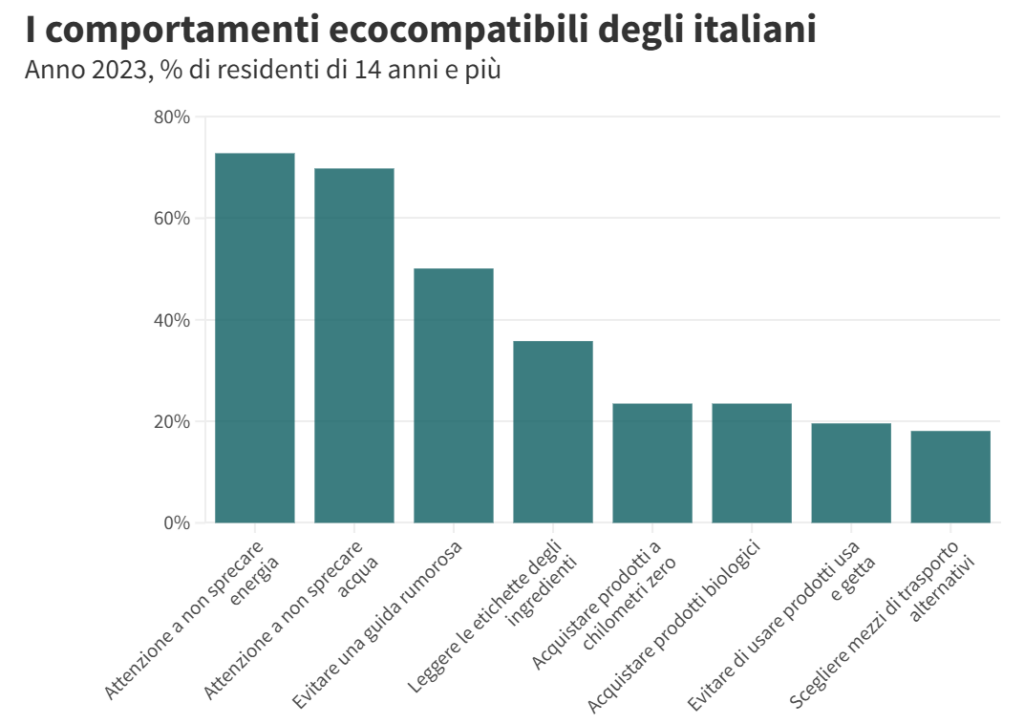
We can all contribute through concrete actions such as reducing water, food, and energy waste, using the car less and favoring public transport, cycling, or car sharing, and choosing local, organic, or low-impact products. Even small changes, if adopted by many, can make a difference.
The role of companies in the ecological transition
Companies have both the responsibility and the opportunity to reduce their environmental impact by adopting strategies such as the transition to renewable energy, circular economy models, digitalization, and waste reduction. A sustainable company is more resilient, attractive, and competitive.
WildSteps’ approach for companies
WildSteps supports companies on their journey toward sustainability, offering team-building experiences that promote respect for nature and environmental awareness. Each activity encourages personal and collective growth within real ecosystems.
Measuring impact in WildSteps events
Corporate activities such as team building can and should also be measured in order to assess their real impact.
WildSteps has developed a specific method to monitor and evaluate what happens during its immersive events in nature.
Through environmental and social criteria, important data are collected and then presented to companies in the form of detailed reports, useful for reporting, communication, and continuous improvement.
The main criteria are:
- Psychophysical Well-Being: assesses the improvement in participants’ mental and physical health through contact with nature.
- Employee Engagement: measures the increase in the group’s sense of belonging, motivation, and cohesion.
- Nature and Health: analyzes the interaction between the activities and the local ecosystem, promoting practices that protect biodiversity.
- Citizen Science: encourages employees’ active participation in scientific data collection activities, increasing awareness and impact.
In this way, every team-building becomes an opportunity for responsibility, learning, and positive transformation, with concrete and measurable effects over time.