
Nature conservation is the set of practices aimed at preserving the current quantity and quality of natural capital for future generations.
Table of contents
What do we mean by nature conservation?
The term “nature conservation” refers to those actions, first scientific and then political, through which the good conservation status of “natural capital” is guaranteed over time. This term, in turn, includes biodiversity, the mineral world that hosts it, and all surface and underground resources such as water, sand, gas, oils, metals, and so on.
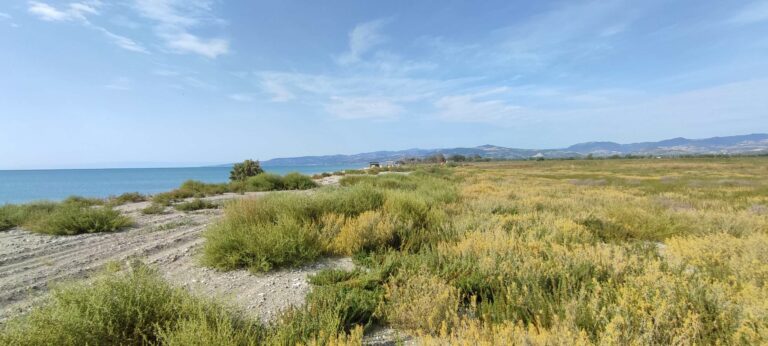
Open spaces near the sea, such as this meadow near the beach of Policoro in Basilicata, are now extremely rare or have disappeared across the Mediterranean. Among the causes are the ever-increasing consumption of land and their underestimation by public opinion.
In fact, when people generally talk about “nature conservation,” they often think only of forests, forgetting all the environmental heterogeneity that makes this world so rich, varied, and unique.
Why is nature conservation important?
The importance of conserving natural capital lies in its key role for the generations of men and women who will come after us.
Humanity’s food, energy, and social well-being directly depend on raw materials and biodiversity. Therefore, a good conservation status of these natural elements guarantees over time:
- fewer famines
- fewer extreme weather events
- fewer energy crises
- fewer wars over natural resources
Ultimately, nature conservation is the most economical and therefore sustainable way to prolong the prosperity of the human species on planet Earth over time. It is also an act of love and respect toward those who will come after us.
How is nature conserved in practice?
There are various ways to conserve nature. In general, we must take into account that the main cause of the deterioration of natural capital is land consumption for agricultural, industrial, and urban use.
This results in the loss of habitats for biodiversity and the extraction of chemical elements from mines and deposits, eventually leading to the depletion of both.
Therefore, on this planet, it is not only life that is at risk: underground materials we take for granted, such as aluminum and zinc, are also now at risk of depletion. For these reasons, the most effective way to protect these resources is to limit their use and abuse through:
- the creation of off-limits or restricted-access areas
- the creation of laws that protect these areas through multi-generational agreements
- public and private bodies that oversee the proper enforcement of these protection laws
Some of these protected areas may include, in decreasing order from the strictest to the least strict: integral nature reserves, national parks, regional parks, oases, refuges, private properties, and gardens. “What?!” you might say. “Gardens?” Well yes: protecting and conserving nature begins right in your own garden! Let’s discover how in the next paragraph.
What can I do to conserve nature?
Those lucky enough to have a small green space inside or around their home can contribute to nature conservation.
For example, in spring and summer, a simple action such as mowing the lawn less invasively and less frequently—avoiding cutting it close to the ground like an “English lawn”—can support, for many months, a multitude of organisms that strictly depend on the micro-refuges found between one blade of grass and another, and between the soil and the grassy layer.
In autumn and winter, however, when the grass no longer grows so vigorously and the leaves fall, it is important to leave a layer of them on the ground. In fact, it provides hibernation sites for a whole other variety of animals. These animals use the layer of warm air between the soil and the leaves to survive the harsh conditions of the two seasons.
In addition to more sustainable management of green spaces at home, balconies included, several actions can help reduce your ecological footprint.
- volunteering at wildlife and plant rescue centers
- citizen science actions, either individually or in organized groups
- more decentralized tourism, toward less-visited destinations
- greater recycling of private waste
- less use of paper and fuel
Conservation and OutBe
OutBe offers services for the protection and improvement of local areas, through a dual and complementary approach: conservation combined with the restoration of natural capital. It is no longer enough to simply conserve what remains; we need to take a further step and begin regenerating what has been lost.
OutBe offers the opportunity to create small artificial spaces to be naturalized in limited areas. We create micro-habitats that help protect breeding, shelter, and feeding sites for the biodiversity associated with them: in one case, with wetland environments, and in the other, with pollen.
The pond project aims to protect one of the most threatened categories of Italian biodiversity at the moment, alongside dune and coastal environments: semi-aquatic vertebrates and invertebrates that strictly depend on still freshwater habitats.
The pollinator project aims to protect another, often overlooked category of pollinators, which includes, among others, butterflies, beetles, flies, and wild bees.
Both projects aim to connect agricultural or industrial organizations that host the spaces to be created with external sponsoring organizations. They do so through the shared goal of making biodiversity more resilient and widespread across the Italian territory. The process follows a scientifically proven and logistically durable method.
Through its team-building experiences, WildSteps gives companies the opportunity to protect nature and carry out activities following the four criteria of regenerativity.