
Too Good To Go Italy, a leading company in the fight against food waste, involved its team in a beach clean-up team-building experience.
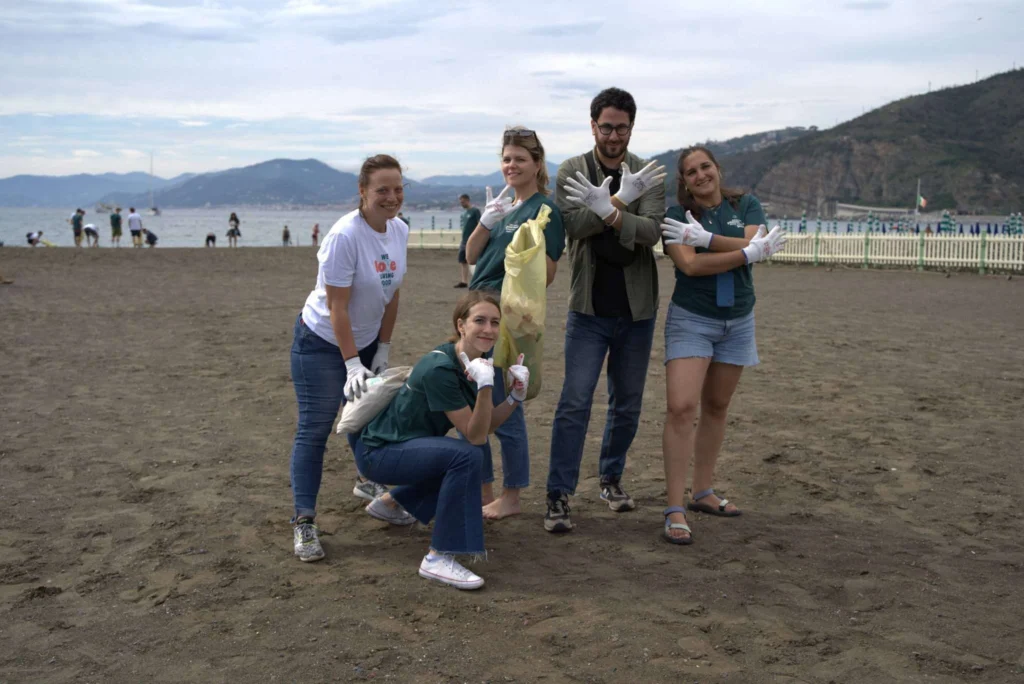
The collaboration, in partnership with The Black Bag, aimed not only to preserve the natural beauty of Sestri Levante, but also to raise the team’s awareness of the environmental challenges facing the coast.
Table of contents
Tackling coastal sustainability in a different way
Too Good To Go Italy adopted a hands-on approach to sustainability during its stay in Sestri Levante. As part of their company retreat, they took part in a beach clean-up organized by WildSteps, using a scientific protocol.
This sustainable team-building activity aimed to preserve the area’s unspoiled beauty and educate participants on how to recognize and categorize waste, increasing their awareness of coastal environmental issues.
“At Too Good To Go, we are committed every day to fighting food waste, a phenomenon that has a significant impact on the environment. We thank WildSteps for the activity carried out in Sestri Levante, which involved our entire Italian team. It was a highly educational moment that increased awareness of environmental protection and the importance of preserving coastal ecosystems.”
Mirco Cerisola, Italian Country Director at Too Good To Go
The clean-up team-building experience: how does it work?
Nature restoration activities, such as beach clean-ups, can help coastal environments and their biodiversity thrive. However, simply removing waste is not enough.
What is even more effective is monitoring the types of waste found and sharing them with research projects. This is what we do during a clean-up team-building experience.
The event began with a scientific briefing by Laura Basaglia, WildSteps marine biologist, and an organizational introduction by Andrea Canepa from The Black Bag.
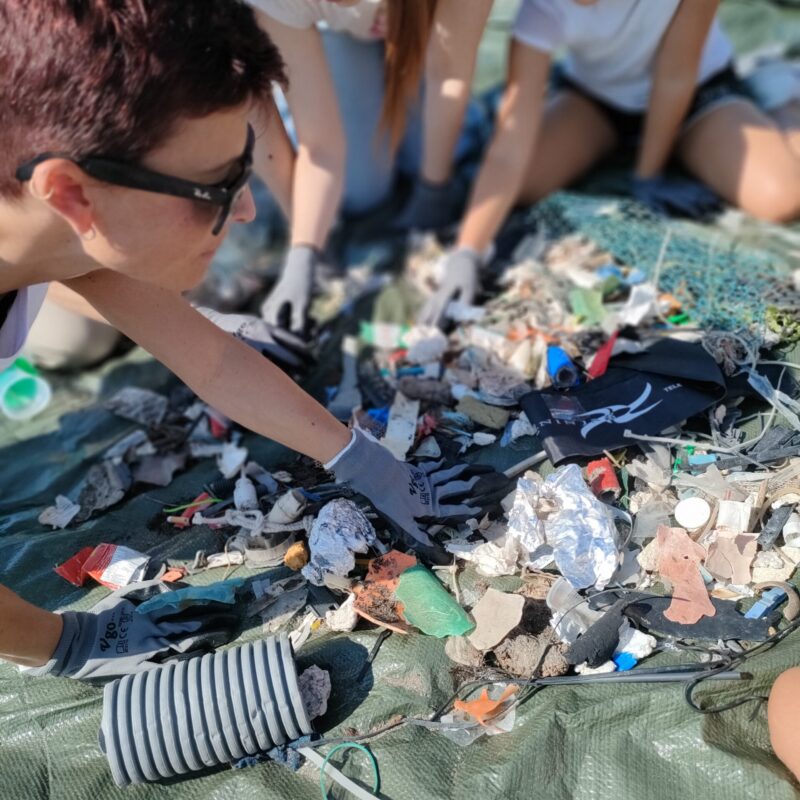
Then, the Too Good To Go team split into two groups: one focused on collecting waste, equipped with gloves and bags, while the other handled the categorization and counting of the items collected.
At the end of the activity, 5,052 waste items were collected, for a total of 18 kg of plastic. Among the most common items found were 2,830 plastic pellets, 1,949 cigarette butts, and 74 pieces of glass.
“We were all together, we collaborated toward a common goal, and we saw our impact in a concrete way — but above all, it was educational.”
One of the participants from the Too Good To Go team
The social and environmental impact of the team-building activity
The clean-up activity played a fundamental role, first of all, in restoring a natural space heavily affected by human activity. Secondly, it made it possible to catalogue the number and types of waste found.
In fact, this information is shared with the scientific community through the Marine Litter Watch protocol, a standardized European approach.
“Following a standardized European protocol such as Marine Litter Watch — developed by the European Environment Agency — allows citizens to contribute to the collection of data that is useful for creating international policies.”
Laura Basaglia, WildSteps marine biologist
Laura emphasized the threefold importance of beach clean-ups:
- the physical removal of waste supports ecological restoration
- the collection of useful data supports scientific research and development
- practical experience increases personal awareness and critical thinking
Organize your next team building in nature
This collaboration represents a concrete and tangible commitment by Too Good To Go to supporting a shared culture of sustainability. It is a clear example of how companies can contribute to environmental conservation while also promoting team unity and awareness.
Organizing corporate team building in nature helps engage and raise awareness among a company’s stakeholders. A win-win, right?