
The SDGs (Sustainable Development Goals) are an international collaboration aimed at protecting people and nature. This collaboration incorporates input from governments, companies, intergovernmental organizations, and civil society.
The SDG goals were adopted by the 193 United Nations Member States at the General Assembly in September 2015.
Their purpose is to address issues such as ending poverty, hunger, AIDS, and discrimination, to name just a few. On a more global level, the SDGs aim to protect the planet and ensure that all people in the world enjoy peace and prosperity.
Therefore, the SDGs require the participation of all stakeholders, especially businesses, to use creativity and innovation to solve the development challenges we are facing.
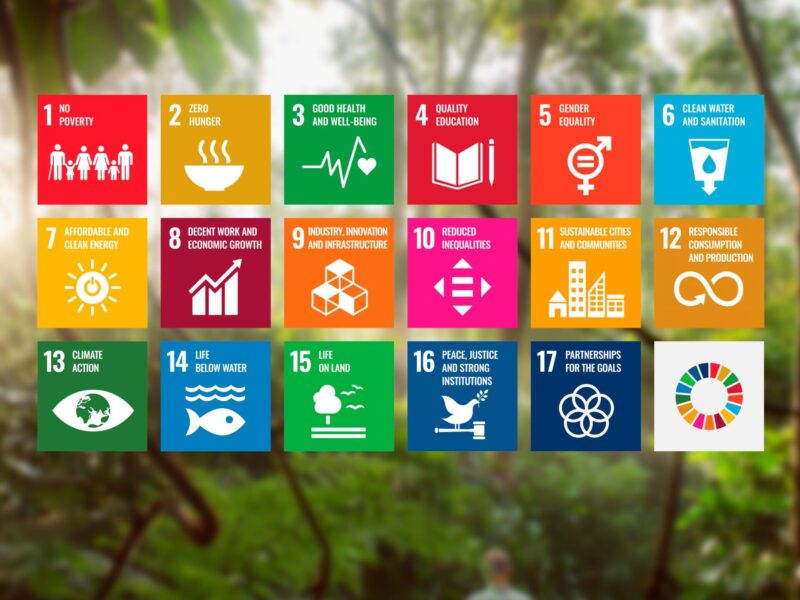
Table of contents
What are the Sustainable Development Goals (SDG goals)?
The SDGs are 17 goals designed to address urgent environmental, political, and economic challenges. The 17 goals are briefly described here:
- No Poverty: Increase resources and basic services, supporting communities affected by conflict and climate-related disasters
- Zero Hunger: Promote sustainable agriculture, support small-scale farmers, and provide equal access to land, technology, and markets
- Good Health and Well-being: Reduce mortality, newborn and child deaths, while also preventing epidemics and diseases
- Quality Education: Ensure equal access to affordable educational training without disparities
- Gender Equality: Give women equal rights, land and property, and provide access to sexual and reproductive health, technology, and the Internet
- Clean Water and Sanitation: Invest in adequate infrastructure, provide sanitation facilities, and encourage hygiene
- Affordable and Clean Energy: Invest in solar, wind, and thermal energy, improve energy productivity, and guarantee energy for all
- Decent Work and Economic Growth: Encourage entrepreneurship, technological innovation, and job creation, in order to eradicate slavery and human trafficking
- Industry, Innovation and Infrastructure: Promote sustainable industries and invest in scientific research and innovation
- Reduced Inequalities: Provide employment for those on lower incomes and promote the economic inclusion of all, regardless of gender, race, or ethnicity
- Sustainable Cities and Communities: Create career opportunities, safe and affordable housing, and build resilient societies and economies by investing in public transport and creating green public spaces
- Responsible Consumption and Production: Urgently reduce our ecological footprint by changing the way we produce and consume goods and resources
- Climate Action: Integrate natural resource management and human security into national development strategies with the aim of addressing climate change, also through education
- Life Below Water: Sustainably manage and protect marine and coastal ecosystems from factors such as pollution, while also addressing the impacts of ocean acidification and biodiversity loss
- Life on Land: Reduce the loss of natural habitats and biodiversity, and support global food and water security, climate change mitigation, adaptation, peace, and security
- Peace, Justice and Strong Institutions: Reduce violence, conflict, and insecurity, promote the rule of law and human rights, reduce the flow of illicit arms, and strengthen the participation of developing countries in global governance institutions
- Partnerships for the Goals: Promote international trade and help developing countries increase their exports to achieve a fair, rules-based universal trading system that is equitable and open to all
Why are the SDGs important?
The SDGs are important because they concern everyone, directly or indirectly, and are therefore highly relevant.
The SDGs of the 2030 Agenda provide guidance for solving the global challenges that the international community must face. In other words, they aim to protect the natural foundations of life and of our planet, everywhere and for everyone, while preserving people’s ability to live with dignity and prosperity across generations.
The Sustainable Development Goals are essential because they address measurable changes in people’s well-being, countries’ economic development, and environmental sustainability.
How can SDGs be incorporated into business strategy?
The SDGs enable alignment between business strategy and the needs of today’s society. When integrated into companies, for example through the implementation of an ESG strategy, they can generate benefits such as:
- Development of business processes, sustainable products, and new innovative solutions
- Greater attractiveness as an employer for young talent and higher retention rates
- New collaborations and synergies
- Positive reputation and brand image
There is a growing demand for sustainable products and solutions. That is why businesses must respond to this sustainable demand by adapting their business model and aligning themselves with long-term development. According to 17 Goals magazine, 72% of companies mention the SDGs in their reports and already contribute by:
- Focusing on the well-being of their employees
- Understanding how production supply chains work
- Being aware of measures to reduce their carbon footprint
- Paying employees fairly
- Investing in the common good
SDGs of the 2030 Agenda
The 2030 Agenda for the Sustainable Development Goals provides a common set of goals. It was built on the results of the Millennium Development Goals that preceded it until 2015. The 2030 Agenda places equality and dignity as its starting points.
The UN SDG 2030 Agenda consists of coordinating and evaluating countries on their sustainable development strategies for achieving the goals and communicating results. Within the 17 goals, there are 169 sub-goals, also called targets, made up of 242 global indicators used to measure the SDGs.
For some of them, there is already considerable methodological consistency, while for others data collection and scientific research are essential to develop suitable metrics. Therefore, the use of non-traditional data collection methods is increasing, for example through citizen science.
The 2030 Agenda requires strong involvement from all parts of society, from private companies to the public sector, as well as civil society and operators in the fields of information and culture.
The private sector must be involved in achieving the SDGs, especially to address the lack of investment in reaching certain global goals. For example, public-private partnerships (PPPs) can increase access to capital, promote sustainable innovation, improve access to services, and help transfer risk.
How can you achieve the Sustainable Development Goals with WildSteps?
WildSteps is an innovative startup that supports companies in creating and implementing a sustainable brand aligned with the SDGs. WildSteps’ corporate services focus on employee well-being (SDG 3), since practicing outdoor activities in nature improves physical and mental health.
In addition, through citizen science actions, anyone can collect valuable data that help conserve and protect the environment and its biodiversity, thereby contributing to SDG 13, SDG 14, and SDG 15.